

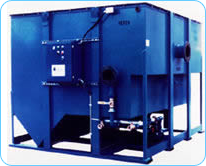
NABA International offers Coalescing Oil Water Separator which will efficiently and consistently coalesce and remove oils from waste water to produce an effluent with 10 mg/l or less of non-emulsified oil. The oil water seperator features a sloped sludge chamber directly under the oil coalescing media to collect settled solids and isolate them from the flow. An internal oil reservoir provides temporary storage for separated oil.
Coalescing Media
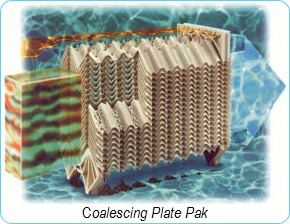
In the residual oil media, fine droplets that are too small to be separated by gravity alone are accumulated into bigger drops that rise to the surface. This coalescing media is made of PP/HDPE/PVC. As the oil/water/solids mixture travels through the plates, oil rises to the top and solids drop to the bottom through dedicated surfaces and weep holes. Plate supports at the bottom allow for easy removal of the solids that collect beneath the plates. And, because of the steep angles and short travel distances, oils and solids are quickly released, making the media virtually self-cleaning
Basic Principle of Oil Water Separation
The concept of a basic gravity oil/water separator is simply a tank vessel that stalls the flow rate to permit gravity to separate oil from water. Oil, having a lower specific gravity than water, will naturally float on water if given time to separate.
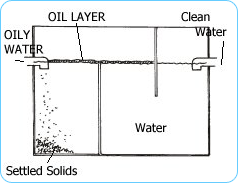
The rise rate of the oil to surface is determined by Stoke’s Law. There are three main factors affecting the rise rate; oil droplet size, oil specific gravity and temperature. Other factors include oil/dirt particles and flow rate or turbulence. According to Stoke’s Law, a 100 micron size oil droplet will rise three inches in five minutes. When factoring in a flow rate, you can see how a simple oil/water separator will have to be quite large to give the oil enough time to rise to the surface. A 20 micron size oil droplet will rise three inches in 60 minutes. Large oil droplets are more buoyant and, therefore, rise faster.
Typical Three-Part Oil/Water Separator
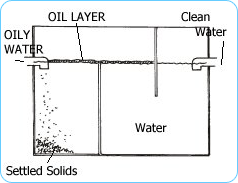
In order to reduce the physical size of the oil/water separator, coalescors have been used successfully for many years. The concept of a coalescor is to use oleophillic (oil loving) media such as polypropylene or teflon. As oil and water flow through the media, oil droplets impinge on the media and coalesces on the surface. Coalescing, or binding together, makes them larger and more buoyant. As you can see from the above example, a 100 micron oil particle will rise three inches twelve times faster than a 20 micron particle.
Now to further enhance this process, we can use these coalescing media as incline plates thereby drastically reducing the rise or fall of a particle.
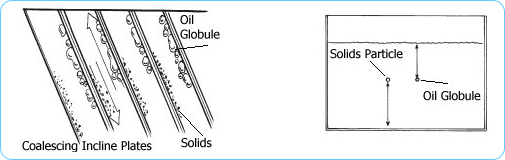
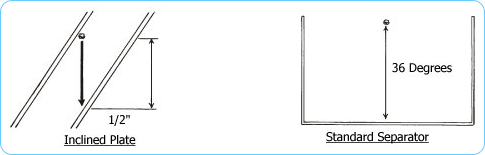
By using coalescing incline plates, the rise of an oil droplet can be reduced to 1/4″ until it hits the upper surface of the plates and glides up as it coalesces with other particles. Also, solids or dirt will settle and glide downward on the plate surface. As it attaches to other dirt particles, the coalesced oil particles will gain buoyancy and rise rate, and the dirt particles will gain speed as they grow heavy and settle at a faster rate.
Example: Solids Settling – Standard Separator vs. Inclined Plates
It takes fine sand 0.1 mm diameter 38 seconds to settle 12 inches in an open tank or 114 seconds in a typical 3 ft. deep separator. By adding ¼ inch incline 60º plates, you reduce the settling time by a factor of 72, Therefore, the addition of ¼ inch incline plates will reduce the settling time of a 0.1 mm diameter fine sand from 114 seconds in a standard separator to 1.58 seconds in a ¼ inch incline plate separator. The same calculation can be made for oil droplet sizes and rise time incline plates.
In addition to incline plate coalescing separation, Chempure utilizes a micro matrix coalescor system of finely spaced poly mesh with an incline grid matrix.
Emulsified oils either chemically or mechanically emulsified will not separate in a gravity separator. Emulsion splitting methods will be necessary before the emulsion reaches the separator. Alternately, quick release detergents or cleaning chemicals can be used, which will release the emulsion and permit the gravity action to occur.