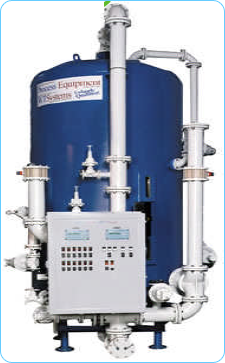
NABA International offers DM plants for producing high quality water for high pressure boilers and process applications.
Basic Process
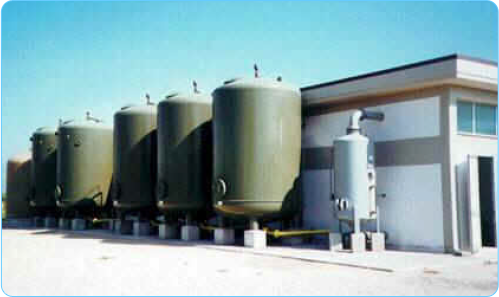
A standard dual bed ion exchange unit consists of a strong acid cation resin that exchanges hydrogen for positively charged cations present. The second step is a strong basic anion resin that exchanges hydroxide for negatively charged anions present in the water stream. The hydrogen (H+) from the cation exchanger and hydroxide (OH-) from the anion exchanger create the HOH or deionized water to be reused in the process.
There are certain processes that generate an abundance of either a cation or an anion. If this occurs, a more selective weak acid cation can be used to exchange the multi-divalent heavy metals that are in abundance. This “pretreating” of the heavy metals will assist in the exchanging of the mono-divalent cations. A weak basic anion before the strong basic anion can be implemented to assist in better deionizing the water fed back to the process.
The cation ion exchange resin is regenerated with an acid to exchange the hydrogen back onto the cation resin beads. The anion is regenerated with sodium hydroxide to exchange the hydroxide back onto the anion resin beads. The cost and wastewater associated with the regeneration of the ion exchange media is minimal.
Ion-Exchange Resin Technology
Applications
- Production of demineralised and high purity feedwater for steam generators;
- Polishing Units for condensate recovery in high performances thermal cycles;
- Production of high purity, demineralised water for pharmaceutical applications;
- Demineralisation processes for food industry.
- stems for removal of heavy metals from washing water in the metals finishing industries.
Demineralisation – Polishing
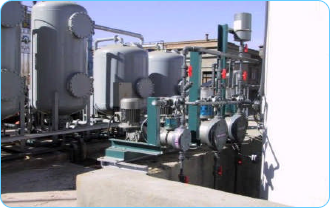
Mixed-Bed Demineralizer
Chempure designs MB units to remove cations and anions (minerals) from water. The term mixed bed demineralizer describes a unit with a thoroughly mixed blend of both cation and anion resins contained in one tank, thus providing the effect of thousands of small two bed units. The MBS-Series can produce water with an effluent quality of 1.0 to 18.3 megohms-cm, and a silica level of 0.10 ppm to 0.01 ppm as CaCO3.
The Basis of Mixed-Bed Exchange:
In many of today’s treatment processes, mixed bed ion exchange plays an integral role. The ions in water can reduce to very low concentrations by exchange with two different ion exchange resins – one charged with hydrogen ions and the others charged with hydroxyl ions. The exchange results in the formation of water. Efficiency of such a system is enhanced when mixing is used. As a hydroxyl ion is released, it helps drive the exchange of a nearby site to produce the ion for the reaction to water. Many treatment processes incorporate mixed bed ion exchange with the use of synthetic ion exchange resins, usually cast as porous beads with considerable external and pore surface where ions can attach. An ion exchange resin is a polymer with electrically charged sites at which one ion may replace another.