

The upflow anaerobic sludge blanket or UASB process is ideally suited to treating industrial wastewater containing medium to high concentrations of soluble organics (i.e. BOD in excess of 1000 mg/L). This anaerobic process requires very little energy (no aeration) and by virtue of its biogas generation, is, in fact, a net energy producer. Carbon is largely converted to methane and carbon dioxide, resulting in virtually no net sludge production.
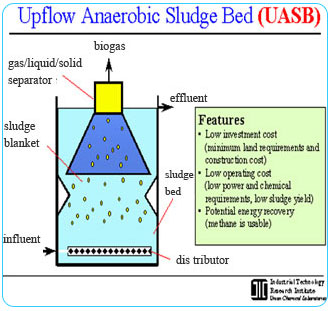
The UASB design has been developed on a modular concept where the digester size can be expanded to any size based on the Geometry of the Pilot Plant. The design has been successfully adapted for various liquid effluents like Sugar Factory, Distillery, and Dairy etc.,
The UASB settlers as well as the roof are in modular construction and the same can be completely fabricated in the manufacturing shop and assembled at site giving necessary dimensional tolerances as well as ensuring quality construction.
Upflow Anaerobic Sludge Blanket Process
The UASB process also relies on upflow velocities to suspend anaerobic solids. However, upflow velocities are much lower than utilized in the AFB process since no carrier material is provided. Instead the anaerobic active mass tends to form a granular type of sludge which assists with its retention in the anaerobic reactor. Various differences between UASB reactors were noted on visits to various European facilities. Some reactors are constructed of concrete; others of steel. Some reactors are rectangular; others are cylindrical. Some are moderate height (6 m); one extended 20 m high. The reactors generally had various proprietary designs for distributing influent and recirculated flows at the bottom as well as three-phase (effluent, solids, gas) separators at the top.
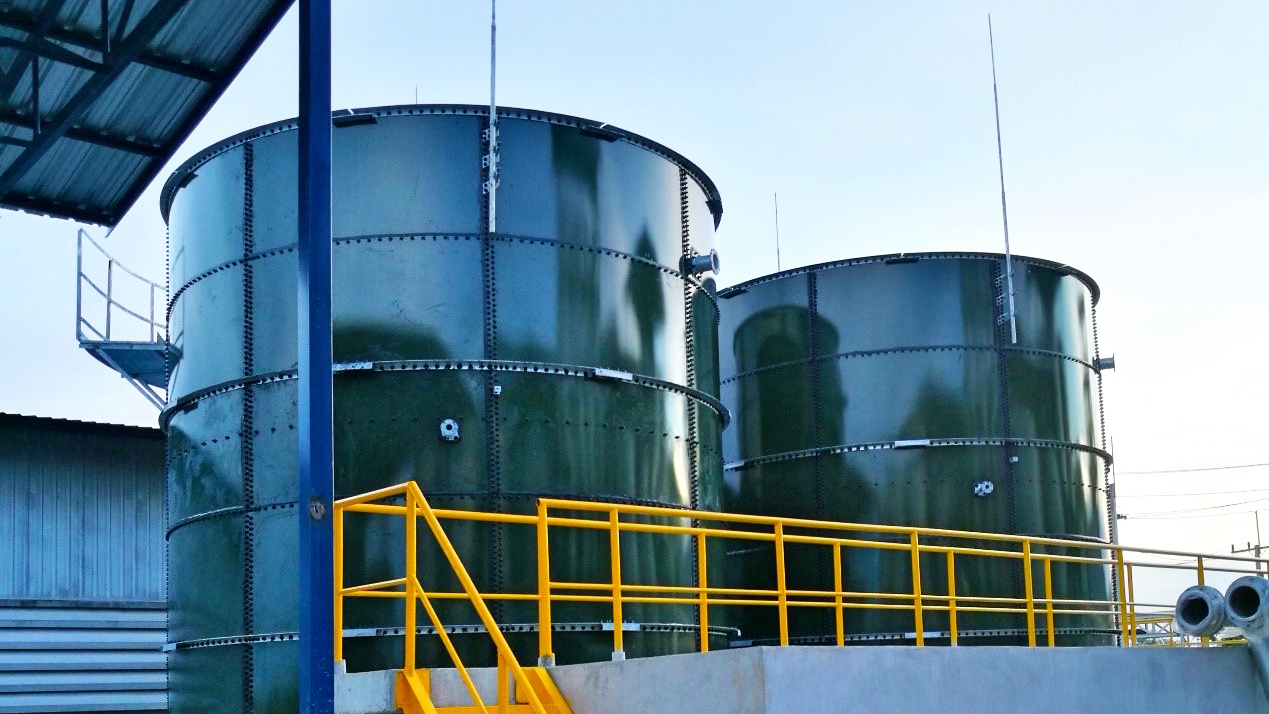
Area of Application
The UASB concept which has been traditionally used for treatment of liquid effluents has been successfully modified for treatment of liquid waste with high concentration of suspended solids like Abattoir waste waters as well as solid waste like Poultry droppings, Kitchen Waste, Vegetable Waste.
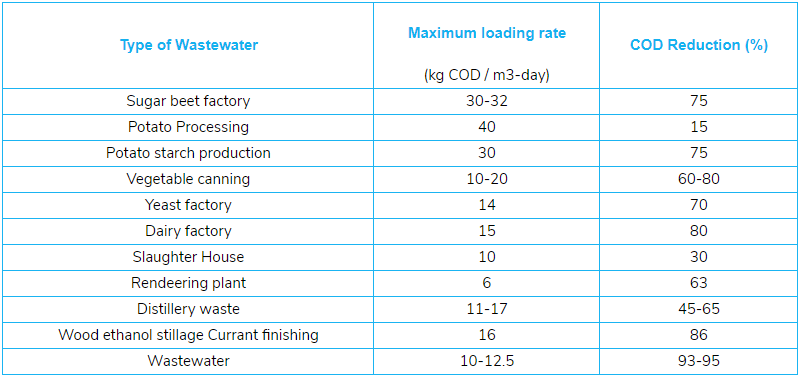
Loading Rates
Design Features
TheChempureprocess is initiated by :
- Soluble organic components in the waste are partially biologically converted to volatile fatty acids (VFAs) in a pre-acidification. The residence time required for acidification is four to six hours.
- The pH of the wastewater is adjusted and nutrients are added, if required.
- The conditioned wastewater is introduced into the reactor, where the conversion of soluble organics to VFAs is completed and the VFAs subsequently converted to an energy rich biogas of methane and carbon dioxide.
- Some treated wastewater may be recycled to return alkalinity to the system.
- The biogas may be used in a boiler or other devices or burnt in a flare.