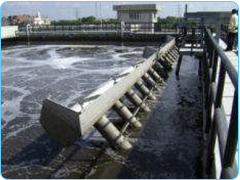
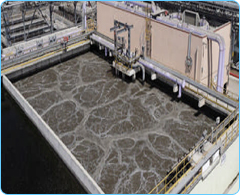
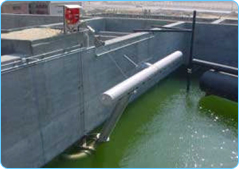
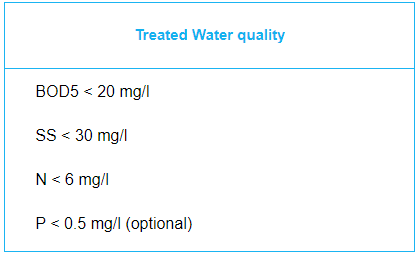
The MSBR has the capability of removing non bio-degradable trash that can harm the electro-mechanical equipment over time as well as produce a very low sludge yield. The overall process produces a very high quality effluent at varying flows and loadings with better control over micro-organisms. The Chempure MSBR can be easily retrofitted into existing tanks and provides increased flexibility as well as power savings over a typical SBR. With the Chempure MSBR we are able to provide a single integrated control system for overall plant performance optimization, as well as a single point of contact for the overall process. This system is ideally suited for plants that have high solids handling costs as well as tight effluent requirements.
SBR Operating Principles
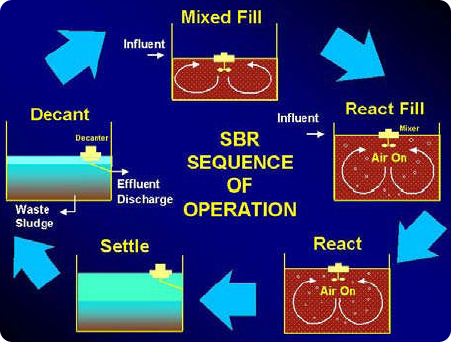
Conventional activated sludge systems require separate tanks for the unit processes of biological reactions (aeration of mixed liquor) and solids-liquid separation (clarification) and also require process mixed liquor solids (return activated sludge) to be returned from the final clarification stage to the aeration tanks. In contrast, SBR technology is a method of wastewater treatment in which all phases of the treatment process occur sequentially within the same tank. Hence, the main benefits of the SBR system are less civil structures, inter-connecting pipe work, and process equipment and the consequent savings in capital and operating costs.
Comparison of Conventional and SBR Process
All SBR’s operate on a time-based process cycle to achieve the process conditions necessary for carbonaceous oxidation, nitrification, de-nitrification and biological phosphorus removal. In addition, solids-liquid separation, treated effluent removal, and solids wasting are also incorporated to complete the process cycle.
The MSBR Process
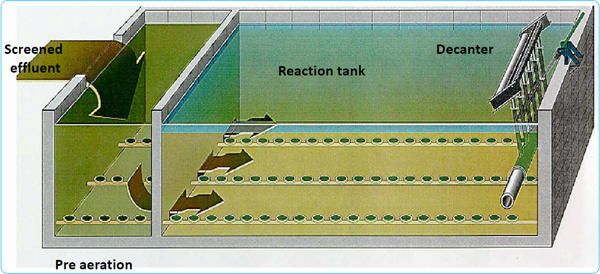
The MSBR is a hybrid of the fill and draw activated sludge vessels. Each cycle consists of hree basic periodic processes: an aeration period, a settling period and an effluent drawing (decanting) period. The operation of the process is time controlled automatically through a microprocessor.
Raw wastewater is continuously fed into the reactor regardless of which periodic process is in operation – aeration, settling, or decanting. Wastewater continuously flows into the prereact chamber where most of the soluble BOD5 is absorbed in the biomass. The prereact chamber acts as an organic selector, increasing the efficiency of the system, helping prevent the development of filamentous organisms. The partially treated waste then flows under the prereact baffle to the main react chamber. The prereact baffle wall also prevents short-circuiting from occurring during the decant phase.
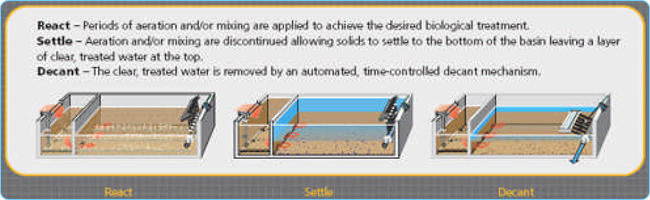
The tank serves as an equalisation basin during the fill period and therefore can tolerate greater peak flows and/or shock loads of Biological Oxygen Demand without degradation of the effluent quality.
MSBR Benefits
- Minimal footprint
- Equalization, primary clarification (in most cases), biological treatment, and secondary clarification can be achieved in a single reactor vessel
- Operating flexibility and control
- Potential capital cost saving by eliminating clarifiers and other equipment
- Lower Capital Cost:
- Simpler and faster installation
- Lower construction costs
- Low sludge volume
- Enhanced nutrient removal
- Quick response to changing influent conditions
- No washout of activated sludge during peak storm flows
- Reduced power·
- Reduced maintenance
- Nutrient removal without costly chemicals
- Easily expandable
- Hydraulic peaks easily accommodated
- Handles shock loads without degradation of final effluent quality
- Control system provides high flexibility